


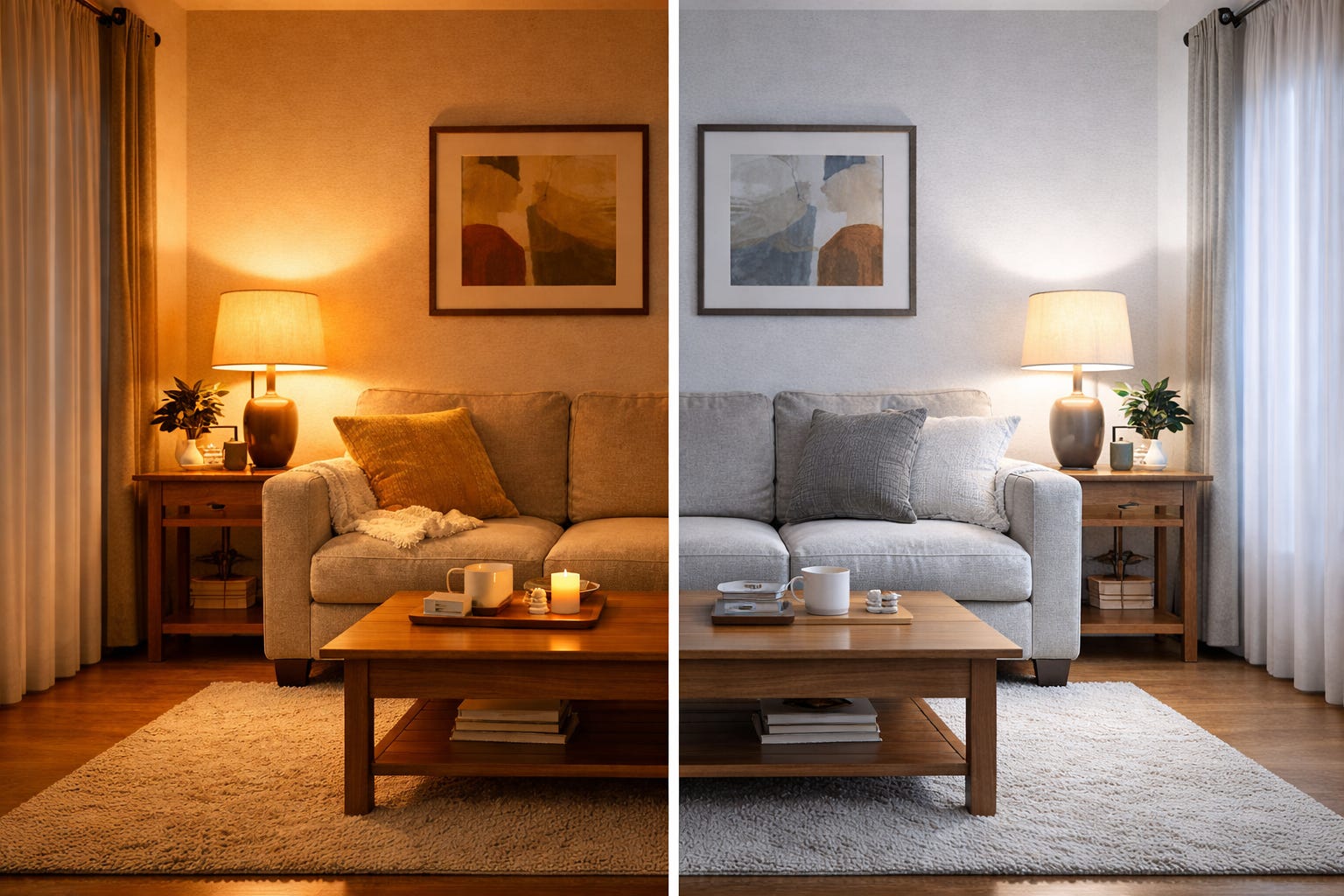
1. The System Error
In 2015, a poorly lit photograph of a lace dress caused a global system crash. It wasn’t just a viral meme; it was the accidental exposure of a biological secret. It proved that “Reality” isn’t a single, objective broadcast that we all tune into.
The cultural assumption is that light enters our eyes, strikes the retina, and sends a flawless video feed to our consciousness. If this camera metaphor were true, every single person looking at that photo would have seen the exact same colors.
Instead, humanity split into two fiercely divided camps. One saw White and Gold; the other saw Blue and Black.
The objective fact? The pixels on the screen were identical for everyone. The divide wasn’t out there on the internet. It was a localized glitch happening inside individual human processors.
2. The Diagnostic Test
Look at the image below. Do not analyze it. Do not try to remember what the internet told you a decade ago. Just look at it right now, in your current environment, with your current eyes.
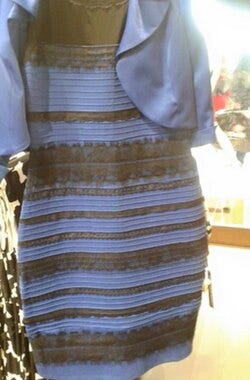
Now, log your hardware’s current calibration:
If you see White and Gold, your hardware is telling you one absolute truth. If you see Blue and Black, it’s telling you another. Globally, the hardware split sits around 57% Blue and Black, 30% White and Gold, and 13% fluctuating.
The “Gold” or the “Deep Blue” you are experiencing does not exist on your screen. It is being actively projected from inside your own skull.
3. The Hardware Specs
How do we know the color isn’t on the screen? Because if you take a digital color picker tool and sample the exact pixels of the image, the software reveals the cold, mathematical truth: the pixels are actually a muddy, neutral tan and a muted violet-blue.
The vibrant gold or the deep midnight black you are looking at is a total fabrication. Why did your internal engine choose to display that specific setting?
It comes down to a hardware algorithm called Color Constancy, driven by a process known as Top-Down Processing.
Because the photo was taken with poor lighting and no clear background context, the brain doesn’t know where the light source is coming from. It faces a massive data deficit. To hand you a stable image, it is forced to guess the environmental lighting and subtract it from the equation. It essentially asks: “What color is the light polluting this room? I need to filter that out so I can show the user the ‘true’ color of the object.”
Your brain’s specific choice of subtraction is determined by your biological firmware—specifically, the light you have spent your life “ignoring.”
[Raw Ambiguous Data]
         │
         ▼
[Color Constancy Filter]
         │
         ├─► (Assumes Cool/Natural Light)  ──► Subtracts Blue  ──► Renders WHITE & GOLD
         │
         └─► (Assumes Warm/Artificial Light) ──► Subtracts Yellow ──► Renders BLUE & BLACK
The Shadow Render (The Lark): Research suggests that if you are a morning person who spends your life under the blue-heavy spectrum of natural sunlight, your brain’s code assumes blue light is environmental “pollution.” It automatically subtracts the blue tones, leaving your consciousness to perceive the dress as White and Gold.
The Artificial Render (The Owl): If you are a night owl who spends more time under the yellow-heavy spectrum of artificial LEDs and indoor bulbs, your brain assumes yellow light is the pollution. It filters out the yellow tones, leaving your consciousness to perceive the dress as Blue and Black.
Your brain looked at the messy, ambiguous data, reached into its own history of light and shadow, and made an executive decision. It didn’t ask your permission. It simply executed the code and handed you a finished render as “The Truth.”
4. The Rendering Log
The reason this glitch feels so personal—and why people argued so heatedly about it—is because it threatens our most basic assumption: That if we are standing in the same room, we are seeing the same thing.
We aren’t.
We are each wearing a built-in biological VR headset. Two people can stand side-by-side, look at the same object, and inhabit two entirely different visual universes. Color is an inside job.
But once you accept that your visual hardware inventing a color that isn’t there just to keep the simulation stable, the floor starts to fall away. What else is it rendering?
Think about the texture of your shirt, the timbre of a distant voice, or the taste of your morning coffee. Are these objective qualities of the universe, or are they just user-interface icons created by your hardware to help you navigate a reality you can’t actually perceive?
The rabbit hole goes even deeper. What about the emotions that flood your system? The sharp spike of anxiety, the warmth of comfort, or the heavy weight of frustration. Are these direct reactions to the outside world, or are they just more complex, internal renderings? Is a “bad day” just another filter your headset applies to raw, ambiguous data—much like it projects “Gold” where only a muddy-brown pixel exists?
If your hardware cannot be trusted to show you the true color of a simple dress, it cannot be trusted to show you the absolute “truth” of your life situations.
You aren’t a passive camera filming a fixed world. You are a real-time rendering engine, hallucinating your reality into existence from the inside out, one frame at a time.