


If you’ve spent any time navigating the world of personal development, mental health, or self-discovery, you’ve likely found yourself caught between two dominant, noisy extremes.
On one side, you have the Clinical/Rational approach. It treats you like a meat computer. If you are anxious, depressed, or struggling, it’s a “chemical imbalance.” You are broken, and you need a clinical intervention to patch the software.
On the other side, you have the Spiritual approach. It wraps human experience in a heavy layer of cosmic mysticism. It tells you that you need to “raise your vibration,” clear your “energetic blocks,” or manifest a new reality by connecting to “Universal Consciousness.” It turns a practical understanding of the mind into a lifelong quest for enlightenment, leaving millions of people permanently trapped in a cycle of “seeking.”
I created The Rendered World because I had a profound realization that completely rejected both of these narratives:
We don’t need a spiritual explanation to understand how our experience is created. We just need to understand the mechanics of the machine.
The Projector vs. The Camera
Almost all of our human problems—from toxic arguments with our spouses to massive political polarization and the current mental health crisis—stem from a single, fundamental hardware misunderstanding.
We live under the delusion that our eyes are cameras recording an objective reality “out there.” We believe that what we see is exactly what is happening, and that anyone who sees it differently must be broken, lying, or malicious.
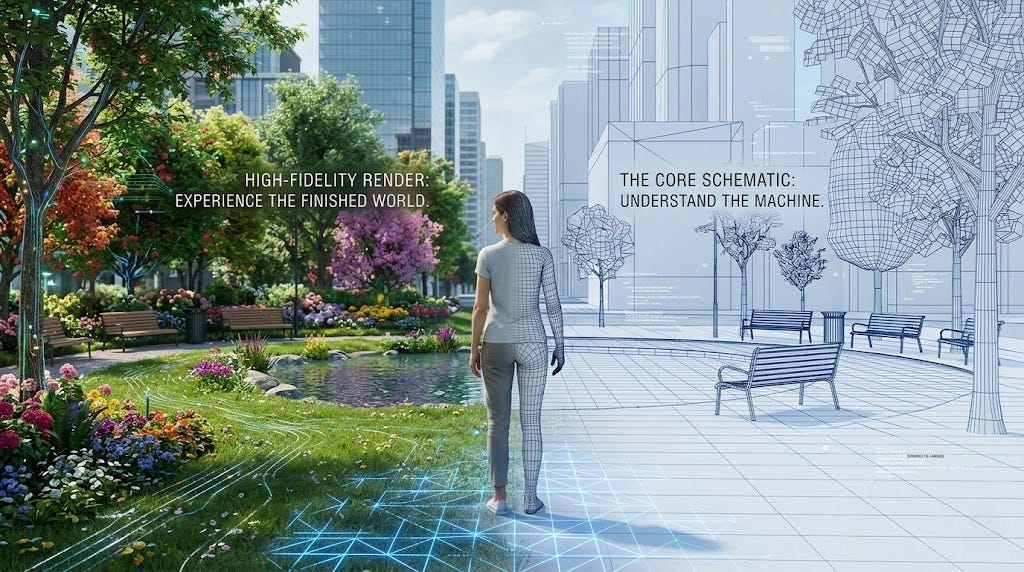
But modern neuroscience and physical biology tell us the exact opposite: Your brain is not a camera. It is a real-time rendering engine. Your eyes send a chaotic, messy, bottlenecked stream of ambiguous data down the optic nerve. Your brain takes that raw data and performs an incredible act of assembly. It filters it, enhances it, and—most importantly—augments it using your past memories, expectations, and embodied understanding of the world.
It colorizes the pixels. It creates the objects. It projects a custom-made, high-fidelity 3D simulation directly onto your consciousness.
We don’t observe a finished world that exists “out there”; rather, the world we experience is an internal reconstruction, rendered moment-to-moment from within.
Why the Spiritual Mysticism Gets in the Way
When ancient traditions or modern gurus look at this process, they correctly identify that our senses are not reporting objective reality. They realize that the world we see is a construction, so they call it Maya (illusion) or talk about “Universal Thought.”
But wrapping this process in spiritual language actually obscures the truth. It makes it mysterious. It makes it seem like peace of mind is something you have to “attain” through meditation, rituals, or intellectual gymnastics.
It isn’t. It is an operational reality.
When you understand that your anger, your anxiety, or your judgment of another person is just a predictable output of your rendering engine, the game changes. You stop fighting the projection on the screen and start understanding the projector itself. It moves “enlightenment” away from mystical concepts and turns it into simple user competency.
What You Will Find Here
In this section, The Rendered World, I will be using my raw human voice to pull back the curtain on how this massive misunderstanding plays out in our culture, our relationships, current events, and the mental health establishment. We are going to look at the massive human consequences of mistaking our internal simulations for objective truth.
I promise you right now: There will be no metaphysical abstractions here. If you are the kind of person who reads an essay and thinks, “Wait, is my brain really doing that? Prove it,” you can step directly into our sister section, Engine Mechanics. There, you will find a cold, data-backed reference library filled with the hard neuroscience, biological glitches, and optical physics that prove everything we discuss here is a physical fact.
We are all living in custom-made renders, hoping our projectors are running the same software. It’s time to stop fighting over the projections and finally look at the machine.
The Foundational Manual
To help you get the most out of these posts, I’ve written a core guide called Rendered Reality. It’s a straightforward user manual for the human experience, explaining the basics of how we create everything that we see and feel.
I’ve made the digital version free for everyone in this community so we can all start from the same page. Just click the button below to download the manual instantly—no checkout carts or digital hoops required.